In photography, vantage point refers to the angle that a photo is taken in relation to the subject, but when considering a photograph as a piece of visual culture that presents an argument, vantage point becomes a multifaceted concept. Two photographs, “Love Joy Church in Rural Alabama” and “Love, Love, Love” are taken from two opposing vantage points and in almost every visual sense, these images contradict each other, but the message of these images become the same under the universal understanding of love shaping a landscape.
These images affirm love beyond a narrow definition, as in the aforementioned quote, Orgeta is validated in these works by their illustration of love as a communal pursuit, the air thickening with love, when many people are joined together. Through examining the visual elements of these photographs, this argument reveals itself in each work.
The subject of the photograph is a white building that takes up about ⅓ of the total composition of the photograph. The building rests upon a foreground of gravel and crabgrass, with no formal road or path leading up to it. The structure is simple, made from cinder blocks and vertical wood boards atop the cinder block rectangle base that creates a pointed roof, topped with a thin line of black roofing, although the exact material is not clear to the viewer from the angle of the photo. The building appears at a slight incline to the viewer. There is a light black mildew crawling up the There is a small overhang that mimics the shape of the roof, with askew lettering that reads, “LOVE JOY”. The shape of each letter is uneven and uniquely malformed suggesting that it was handmade, and decayed over time. Beneath the overhang there are two thin, white painted poles, dark brown double doors carved with basic squared design. There is only one doorknob. Beneath the doors is a single wide concrete step that doubles as a small porch. The white poles connect to this concrete step. The Church has no windows. There are patches of bright green grass surrounding the foreground and the background of the landscape, interspersed with the gravel and brown dirt. The structure is slightly off center, about four to five degrees to the left in the composition, but it remains clearly the austere subject of the photo. To the left and slightly behind the church there is a tall lamp post, made from a thin piece of lumber. There are no wires attached, it appears out of commission. The background appears lush, with a fresh green surrounding the church. There are fewer trees on the left side of the structure, revealing a patch of grey sky. On that same side, there is the log of a fallen tree, being overtaken by ivy. Immediately behind the church, there is a tree full of foliage, almost appearing to sprout from the apex of the roof. There are three distinct trees to the right of the structure. The largest of the three is also the closest to the foreground, and from it sprouts a robust number of thick branches that create a partial canopy above the church. Behind, and to the slight left of the structure, a sparse and thin tree stands, interrupting the pocket of grey sky. The ground in the background of the photograph is covered in approximately knee-height green grass. Farthest from the foreground, but still within the eye-line of the viewer there appears to be a wall of ivy, or indiscriminate foliage. The lighting is muted, with a limited color scheme.
It is clear to the viewer that this is the image of an abandoned gathering place, a relic left over from a community that necessitated a hastily built structure for worship. This cultural center has since fallen into disrepair, as the lettering above the entryway slips lazily from rusting nails. The humid air weighs on the scene, causing a grey mildew to creep up the sides of the once fresh paint. There is a history communicated in this image, the rise and fall of small town America is displayed to the viewer through the abruptness of the stout faded structure against a background of expansive foliage, while the barrier between nature and human interjection into it falters, as the mildew creeps around the corners of the building, beginning the process of decomposition. Love is an undertone in the piece, the lettering “LOVE JOY” hangs almost sardonically as if adding a cartoon caption, the black lettering against the white page of the church’s fading paint. Yet this is not a parody. The soft light of a clouded day reveals the church among the trees tenderly. The church is framed by the canopy of naively green branches. This photograph was taken with a sincerity.
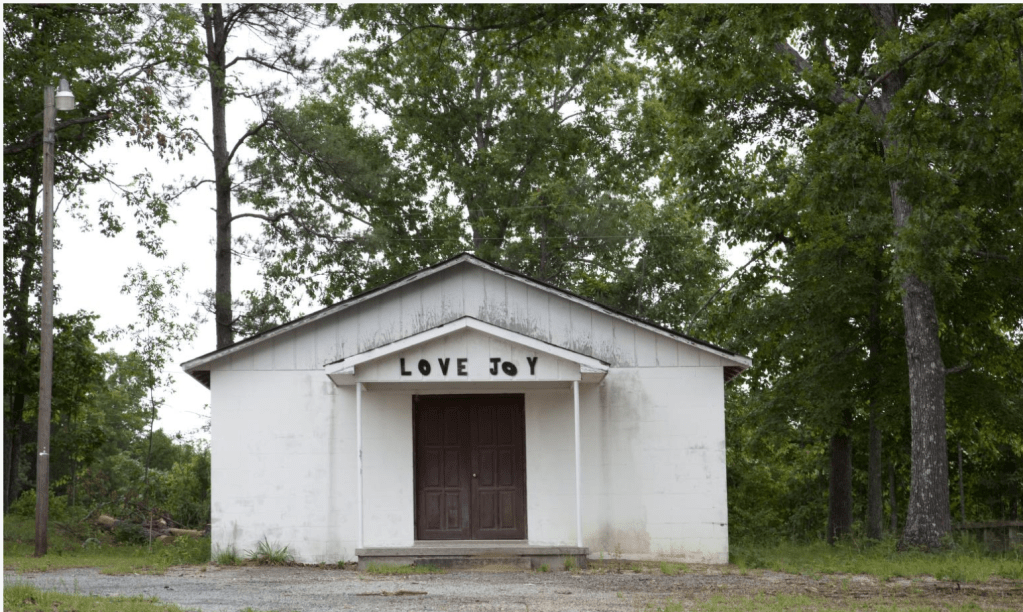
The vantage point of the photographer holds space for a nostalgia of rural life, an invention perpetuated by the Americana myth. Carol Highsmith, the photographer, describes her work as fundamentally a patriotic endeavor. The mission statement accompanying the collection of photographs that “LOVE JOY church in rural Alabama” being “I am living my dream, all across our sweet land of liberty, America.” Highsmith is a southern woman, coming from, as she describes, “a generationally owned successful tobacco farm.” This photograph was not taken from the perspective of someone who was a member of the community. The romance in the tone of the photograph honors the earnesty of the creators of this structure, while candidly displaying the decomposition of the building. The negative space of the piece yearns for the fulfillment of people to surround the structure, to sit on the steps, and bring truth to the label “LOVE JOY”. Highsmith does not occupy a position that would facilitate the documentation of the congregation at its fullest.
This image documents a loss, in the words of Bell hooks “it is far easier to talk about loss than it is to talk about love. It is easier to articulate the pain of love’s absence than to describe its presence and meaning in our lives.” The image the viewer is given communicates the sweetness of the Alabama scene, simplifying the experience of rural poverty in a manner only someone who does understand the ache of an unfed stomach is want to do. Though, the image does not completely miss the mark. Highsmith, considering herself a documentarian of America, manufactured an image that allows the viewer to invent memories of the structure, and the people who once inhabited it. The church, when considered through the lens of a documentarian of culture, displays a clear weight. This structure was not built extravagantly, i this is clear through the materials used to make the structure, cinder blocks and concrete, but it was done with care. The central value of the builder being “LOVE JOY” as it that phrase was chosen to adorn the entryway of the structure, the only building in the apparent surroundings. United under that roof, the viewer is encouraged to imagine a community that worships under the command of “LOVE JOY”.
Love, Love, Love. by Camilo José Vergara
The subject of this photograph is a group of people waiting at a crosswalk. This is a cityscape, the background including a number of different buildings of varying sizes, styles, and states of repair. The sidewalks are busy, while the street is somewhat empty, with only one car in the oncoming lane, waiting at the intersection. Closest to the viewer in the right corner of the foreground is the upper torso of a woman, who stares towards the left at a 3/4ers profile with an inquisitive, squinting look on her face with her mouth slightly open, as if she was in the midst of speaking. Her hair is short, with cornrow braids framing her face ending at the crown of her head. She has one silver piercing in her ear, and Her left arm is the subject closest to the viewer in the composition. She wears a white short sleeve shirt with four black stripes on the arm, the two innermost stripes in white block lettering state “LOVE, LOVE, LOVE”. She is in shadow. The other figures are in a bright yellow light, as if the sunlight came through a smoky haze. In the center of the composition, a stone building is in the farthest aspect of the background that is visible to the viewer. This building is situated on the corner, and both sides of the building are visible. From left to right, the ground floor signs lining the street are Liberty tax service, Taco Bell, tobacco kings, golden krust on the Nostrand Ave. Side of the corner. On the Fulton side, the signs read Golden Krust, metro PCS, Burger King, and Supermarket. Along the sidewalk there are street vendors and pedestrians. There are six people on the same corner as the photographer, and they fill most of the foreground. From right to left, discounting the previously mentioned woman in the right corner, there is a woman with a stroller, facing away from the camera- with just the feet of the baby peeking out of the pram, in the dead center of the composition an older man with a black sweater wrapped around his shoulders caught mid stride walking to the right, he looks forward with a squinting look. Right next to this man, is the back of a man wearing a thick dark coat, and a black truckers cap. Two women in dark clothing stand next to him with their arms crossed, one is shorter than the other. The taller woman is turned to the shorter woman, as if she is saying something to her with her arms crossed. Farther in the background, in front of the woman when oriented towards the crosswalk, a man in a light blue collared shirt. These three figures all have their backs to the photographer. All the people in the foreground of the image have their entire bodies included in the composition, and an intense interplay of shadows and bright light is painted across these figures.
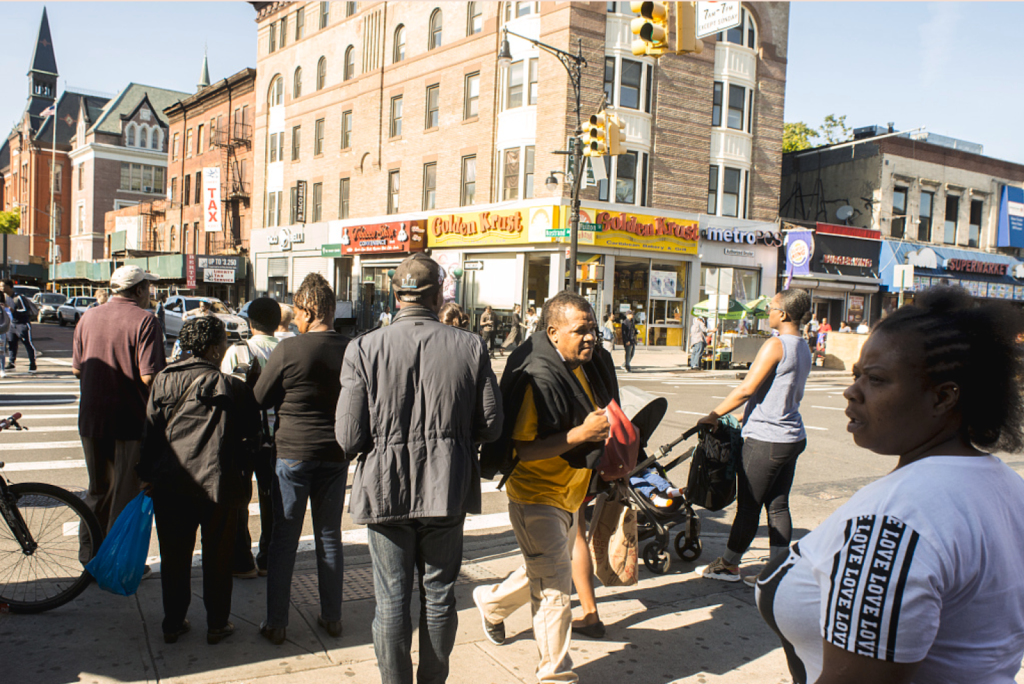
Love, Love, Love by Camilo José Vergara is a photograph documenting a busy intersection of a neighborhood. He describes himself as a “a historically conscious documentarian; an archivist of decline.” In his work he focuses solely on documenting distressed urban areas. This particular image is of the intersection of Fulton street and Nostrand Ave, in Brooklyn, NYC. The tone of this image is decidedly unromantic. The lighting is harsh, the atmosphere lies heavy, filtering the sunlight through the city air. The people in this image squint, burdened by the harsh daylight. None of them smile. Vergara is not an outsider to this scene. Beginning his work in 1974, within the past five decades, he photographed urban landscapes, having grown up in the dense city of Santiago, Chile. The vantage point is among the unknowing subjects, the camera close to them, to reveal their affect in all of its glory. The choice to have the foreground of the image state “LOVE LOVE LOVE” in this tense scene is an affirmation of the “gravitational force of love” to shape our urban fabric that Ortega refers to in this book “On Love”. This scene does not dull the stress these people are experiencing, nor does it make an effort to unduly unite or romanticize them, yet love is evident in the connections included in the scene, those of mother and child, friends standing together, and the grounded vantage point of the photographer. Vergara works to pull the viewer into the scene, making you one of the pedestrians on the crosswalk. His photography as a practice is a labor of love celebrating in lucid glory the failures, pressures, and beauty of these urban landscapes that he documents. His practice gravitates towards a whole concept of the urban, trying to extend past the barriers of film.
These two photographs play off each other in an almost contradictory fashion. One photo is shaded by cool ancient trees and the other is in the harsh New York midday sun, one a scene of abandonment, the other is one of congestion, and yet both can create a unified argument for the gravitational power of love in our lives, as something we are both surrounded and controlled by, and are inexplicably at the will of. Much like the muniate of physics that describes gravity, there is something fundamentally mysterious about how we encounter love in our lives and the power that it holds. We lack the ability to even adequately define what it is in our personal experiences, let alone what love means in a neighborhood, or a city. But nevertheless, we experience it, we are shaped by it, and through our lives we shape the city. In these two images we are pushed to imagine love in an infrastructure that is ultimately hostile to the concept, enforcing the inescapable hold that love has over our lives and landscapes.
For more American Photography Explore the Library of Congress Archives (while you still can!)
https://guides.loc.gov/vergara-collection-guide/old-nyc-and-more-themes
This article was first written for “All about Love” an American Studies Course at University of California, Berkeley in 2021

 The Urban Legend
Leave a comment